

Key Takeaways
- Entrepreneurial success comes down mostly to how you think and act.
-
A Fixed Mindset will keep you from success.
-
A growth mindset is the thinking that helps cope with the demands of being an entrepreneur.
-
An entrepreneur's Mindset builds on growth thinking but incorporates greater risk-taking and opportunity-seeking.
To get ahead in business and life requires brainpower. That's a no-brainer! Brains mean not only the power to process information but also different aptitudes and approaches to perception and to reacting to the world around us.
Businesses need thinkers who can leverage their cognitive resources to solve problems and identify opportunities. As a business owner and entrepreneur, you must adapt to the new trends in 2026 and beyond. This change can only take place if your Mindset is malleable, and it is all about the psychology of knowing how to do it.
What's a mindset?
The year 2026 will offer many challenges and extreme uncertainty, and that's for sure. The past Mindset will not work, and that's a certainty!
Adaptive brains outperform fixed mindsets in a changing world. But what is a mindset?
Mindset is your way of thinking and acting with all the assumptions you make, the methods, techniques, and strategies you use to cope with the environment around you. When our approach works, it becomes ingrained in our thinking and behaviour, a habit. Habits, though, have a good and bad side.
When we look at the world, we develop mental shortcuts or heuristics. These hacks can reduce the processing load on our brains, as we often need fast answers; however, sometimes these quickies don't yield the best results.
Often, we make assumptions that work well in some situations. Why keep checking the facts when the same job needs to be done? While this frequently works, rapid external changes can lead to a sub-optimal response.
There is the tale of the donkey that tried to cross the river with heavy bags full of salt. When the donkey reached the other side, it was relieved that the load had become much lighter. This lesson came back when he had a pack of sponges, and so the ass tried it again. He was surprised to learn that the technique had the opposite effect. The donkey's assumption was the same, and he did not recognise that his situation had changed. Sometimes we act like asses, trying to use the same strategy and expecting the same result! What gets you here will not get you there.
Fixed Mindset
Some believe that our brains cannot learn beyond a certain age. People with a fixed mindset don't think they have control over their destinies. This belief becomes a self-fulfilling prophecy; they stagnate, and if you hire them, they cannot perform better. If you are starting a business, this Mindset will defeat you before your first customer makes a purchase. This thinking is called the fixed Mindset, and this person is going nowhere.
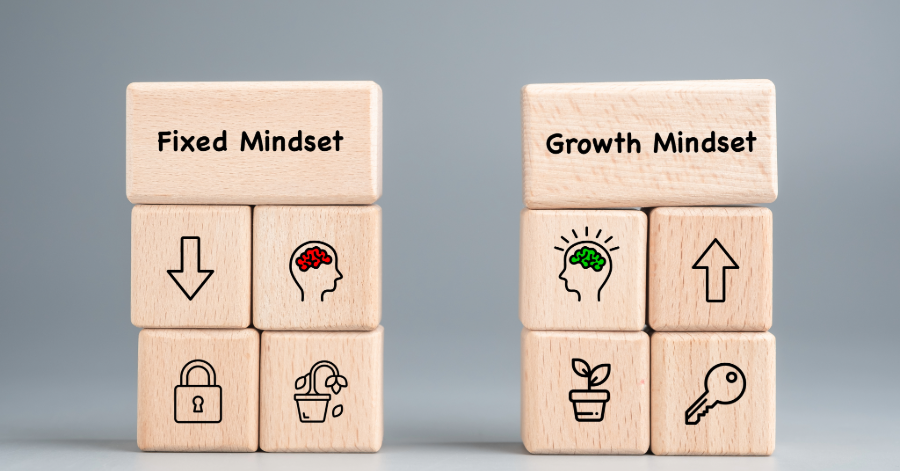
The brain views change as a threat and may offer resistance. This framework may provide insight into why some people have a fixed mindset. We have three brains packaged into one. Our neocortex is our newest brain, and this is driven by logic and rationality, also called our modern mind, which comes in handy with higher-level thinking. The middle brain, the limbic system, deals with fear, threats, emotions, and trauma. The old brain, our third one, reacts to dangerous situations in three modes: fight, flight, or freeze. A person with a fixed mindset is trapped outside of the neocortex and is afraid of change.
Growth mindset
People with a growth mindset love learning and adapting. They form new habits and destroy old ones; this is what makes them flexible. The brain's ability to change is captured by the psychological concept called neuroplasticity. This brain agility comes from new experiences and tasks. Learning a new skill, speaking a different language, using your other hand, or taking a new route creates new pathways in your brain. If the mind is frequently challenged, it grows. There is also a common myth that the brain cells we are born with are not replaced as we age. This fable is not valid; we can still form new connections and expand our cognition.
The growth mindset has many organisational benefits, and Carol Dweck, the author of the bestseller Mindset, cites studies that show people with a growth mindset work harder, learn from experience, and are willing to take more risks to achieve results.
Your growth mindset has many benefits. Some research has shown that people can move out of their comfort zone more easily, push themselves toward loftier goals, experience higher motivation, and experience lower stress. Being able to cope with stress is especially important for entrepreneurs, as discouragement and failure are the norm.
The growth mindset is an excellent coping approach to dealing with anxiety and depression.
Entrepreneurial Mindset
While the central feature of a growth mindset is its learning, this might come across as academic. But an entrepreneur's ability to learn and synthesise information can shape a firm's strategy and change its business model.
A start-up is a business experiment. A new venture owner is testing the environment to determine whether the proposed business model is self-sustaining and profitable. Anyone starting a business knows that the risk of failure is high, and getting feedback and making changes is the key to success. During the embryonic stage, entrepreneurs have to go through many ideas before settling on a business idea to base their business on.
Entrepreneurs need not only a growth mindset but also one that encompasses risk-taking. The entrepreneurial Mindset prefers moderate risks and a propensity for creativity that leads to innovation. Value innovation is what separates entrepreneurs from businesspeople. Dell created a new process for delivering customised computers with the direct-to-customer model. Jeff Bezos developed an innovative business model that enables customers to buy online with ease and at lower prices.
Having the right Mindset is what separates the performers from the average players. Imagine a simple, cost-free psychological concept like Mindset can make a big difference in your life and career.
Sajjad Hamid is an Entrepreneurship Educator who supports entrepreneurs in scaling their ventures. In his spare time in Trinidad and Tobago, he cultivates organic tropical fruits and vegetables, practising sustainable farming in his home garden.
He is the author of Build Your Legacy Business: Solopreneur To Family Business Hero. Sajjad is a Fellow of the Family Firm Institute. You can contact him at [email protected] or visit www.entrepreneurtnt.com.

Responses