
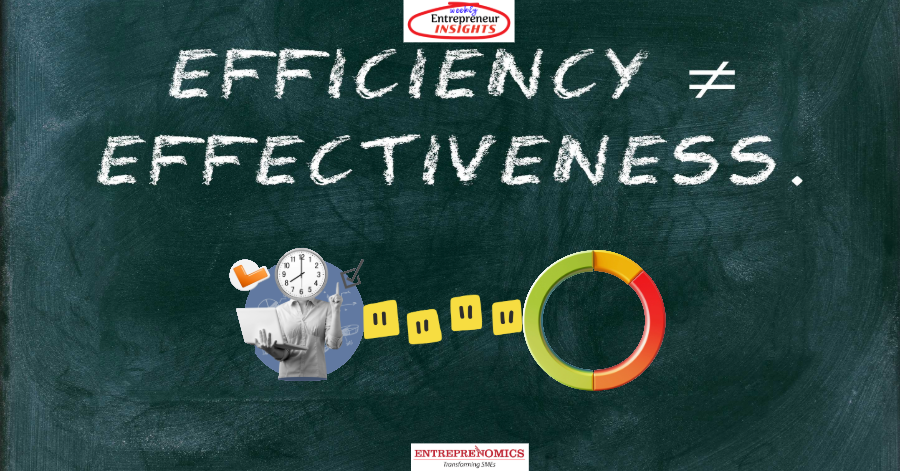
In entrepreneurship, “working harder” is rarely the real problem. Most founders are already pushing the limits of their time and energy. The real issue is usually a quieter one: confusing efficiency with effectiveness.
This is your weekly Entrepreneur Insights 5-minute read with ideas to improve your business.
Both matter, but they are not the same. If you get them in the wrong order, you can spend months optimizing a business that isn’t moving you closer to your goals.
Efficiency vs Effectiveness: What’s the Difference?
Efficiency is about how you do something.
- How fast can you send those emails?
- How many calls can you make in a day?
- How cheaply can you acquire a new customer?
Efficiency is about speed, cost, and volume. It’s doing things right.
Effectiveness is about what you’re doing and why.
- Are you talking to the right customers?
- Are you selling the right offer?
- Is this activity moving the needle?
Effectiveness is about outcomes. It’s doing the right things.
You can be incredibly efficient at the wrong tasks and still end up stuck. That’s the trap most entrepreneurs fall into.
The Busy Founder Trap
Every founder knows the feeling: your calendar is full, your to-do list is long, and you collapse at the end of the day, wondering where the time went.
On paper, you were productive. You answered emails, posted on social, tweaked your post, watched a webinar, cleaned up your CRM, and brainstormed new ideas.
That gap is the difference between efficiency and effectiveness. You were efficient at staying busy, but not effective at driving the outcomes that matter.
A Simple Test: The $10 vs $1,000 Tasks
Think about your work in two buckets:
- $10 tasks: low-leverage, low-impact, often administrative
(formatting, minor design tweaks, inbox zero, rearranging project boards)
- $1,000 tasks: high-leverage, high-impact, often uncomfortable
(making an offer, sales conversations, partnerships, launching, raising prices, refining your core message)
You can be highly efficient at $10 tasks and never touch a $1,000 task for days.
Effectiveness means ruthlessly protecting time for $1,000 tasks, even if you are clumsy or slow at them. Efficiency can come later, once you know you’re working on the right things.
Why Effectiveness Must Come First
If you optimize for efficiency too early, three things happen:
1. You scale noise instead of signal.
You double down on activities that feel productive but don’t move key metrics.
2. You avoid real work.
Hard, high-leverage decisions get postponed: choosing a niche, clarifying your offer, setting a bold price, and asking for the sale.
3. You burn out without a clear win.
It’s exhausting to stay busy without tangible progress. Burnout doesn’t come from hard work alone; it comes from hard work without results.
A Practical Framework: Effective First, Efficient Second
Here’s a simple way to apply this in your business:
1. Choose one core outcome for the week.
Examples: “Book 5 sales calls,” “Pre-sell 10 seats in my new program,” “Publish a sales page and send one launch email.”
2. Identify the 3 most effective actions that drive that outcome.
Not 20. Just 3. These are your $1,000 tasks.
3. Schedule these first.
Put them in your calendar as non-negotiable appointments with yourself.
4. Protect them from efficient distractions.
No “quick inbox check” first. No touching design details. You earn optimization after you’ve done the effective work.
5. Only then optimize.
Once you see what’s working, streamline: create templates, build automations, delegate the repeatable pieces.
Next step
Before you implement this, decide on a one-sentence call to action you want at the end of the week (e.g., join your list, book a call, check out an offer). If you share your goal for this newsletter issue, I can arrange a complimentary mentorship session.
Quote for the week
“There is nothing so useless as doing efficiently that which should not be done at all.”—Peter Drucker, management guru and author.
See you next week for another edition of weekly Entrepreneur Insights!
May you always have the mindset of an entrepreneur.

Sajjad Hamid is an SME & Family Business Adviser who supports entrepreneurs in scaling their ventures. In his spare time in Trinidad and Tobago, he cultivates organic tropical fruits and vegetables, practising sustainable farming in his home garden.
He is the author of Build Your Legacy Business: Solopreneur To Family Business Hero. Sajjad is a Fellow of the Family Firm Institute. You can contact him at [email protected] or visit www.entrepreneurtnt.com.
Responses