

Key Takeaways
- Family firms offer lessons in adaptability
- They approach volatility with a different strategy
- These lessons can come from the frontier and emergent economies
- Family businesses use modularity and redundancy, among other strategies
We live in a world of extreme turbulence. The unexpected always seems to be around the corner. How do you design your organisation to align with those radical changes? Sometimes we prepare for the wolf at the door, but ignore the termites in our house. Family enterprises from around the globe have many lessons to share that CEOs could benefit from.
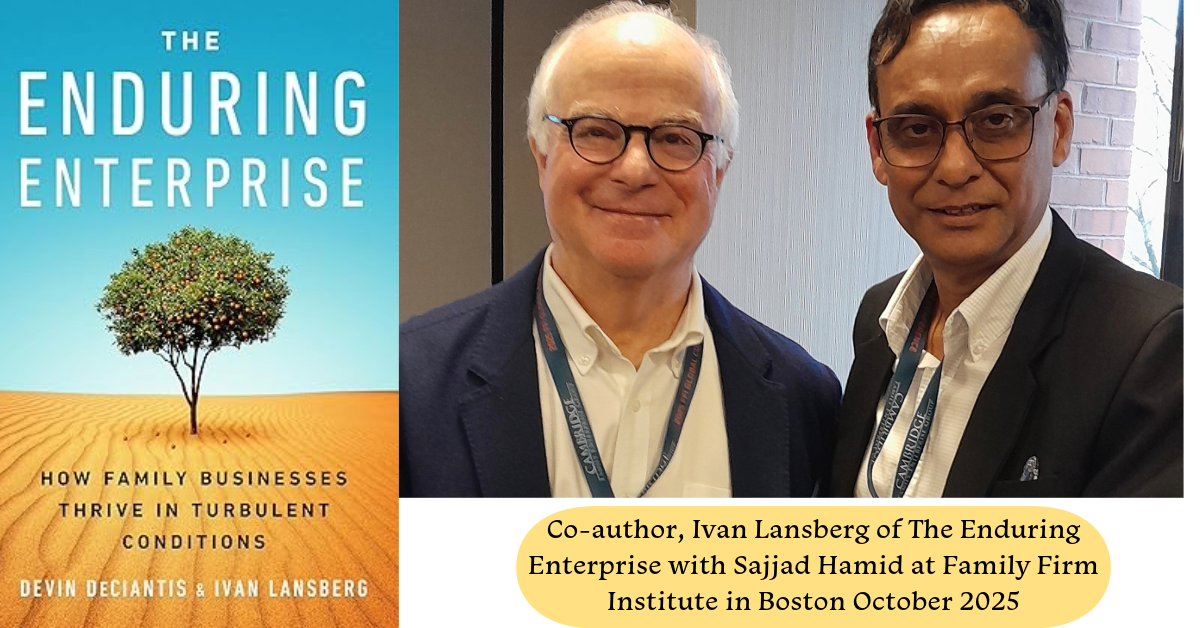
Recently, I had the privilege of hearing the authors of The Enduring Enterprise: How family businesses thrive in turbulent conditions speak at the Family Firm Institute 2025 October Global Conference in Boston. Devin Deciantis and Ivan Lansberg outline why extreme uncertainty will be the norm and cite many family firms in frontier and emerging economies that deploy innovative strategies to survive and flourish.
Extreme uncertainty
While advanced economies have the infrastructure (hard and soft) to promote predictability and stability, emerging ones are more vulnerable to dramatic shifts. It is these family firms in less developed economies that offer valuable lessons for businesses that operate in what the authors call "dancing landscapes". Why family enterprises? Families in business are the dominant form of organisation and often ignored for their contribution.
Stability, it seems, has a downside—while it fosters prosperity, it encourages complacency and a lack of preparedness for black swan events, which are infrequent in the first world. Then there is the word that captures the interconnection of complex risks—polycrisis. It is not just one disastrous event; often, it is the cascading adverse outcomes that create a Halloween occurrence.
So, what strategies do family enterprises use to navigate uncertainty and become resilient and invincible organisations? Deciantis and Lansberg's research identified seven strategies that these ubiquitous firms use.
Differentiation
Standing out through a point of difference—the term popularised by Michael Porter—family ventures tend to focus on underserved markets that are often ignored by larger firms, which many opt to exit for economic reasons at the first sign of trouble.
AJE Group, a Peruvian beverage company, targeted poorer areas with a lower-cost soda called Kola. They used micro-entrepreneurs to sell door-to-door with privately owned trucks. Later, CEO Angel Ananos of AJE Group wondered: if the business model was successful in Peru, what about the other neighbouring nations? The company expanded to Costa Rica, Guatemala, Nicaragua and even Asian states. Their success rests on producing high-quality products at fair prices and supporting grassroots entrepreneurship.
Modularity
A company's parts can be structured to function independently and interdependently. IKEA used modularity in its operations: product design, store layouts and logistics. The IKEA open secret is to design products in a knockdown version, reducing freight and warehouse costs and making it easy for customers to assemble them. It is strange that this technique is not widely used locally, as it would be a way to offer low prices and beat the Courts' dominance.
Symbiosis
In the biological world, sometimes species depend on one another to their benefit. This relation differs from the predator-prey model. Samsung was cited in the book as having a symbiotic relationship with the Korean government, resulting in generous state support. Though this is often the case in other countries, the relationship can draw attention to the preferential treatment these close families have with governments, and it can lead to a backlash, as Adani Group found out when Indians became concerned about its influence.
Redundancy
If it is critical, it should have a backup. When there are many disruptive events, as in Haiti, it makes sense to create redundant systems at the iconic hotel on the island of Hispaniola, Le Plaza. The Pierre-Louis family invested in backups—generators, water supply, telecommunications, and other measures to deal with the frequent political and criminal volatility. It's like the National Geographic television series Doomsday Preppers, but without the 'end is near' scenario.
Migration
Moving to greener pastures has always been humanity's key survival strategy when the environment turns adverse. In the business world, sometimes the political climate may favour nationalisation. There are many cases of entrepreneurs leaving a country due to religious persecution. One group would be the Jews who left Europe to set up businesses elsewhere. Some have left Guyana during the Forbes Burnham regime and later set up companies in New York and Toronto. Laparkan is one of the famous Guyanese cases. Migrant entrepreneurs like the Venezuelans are a boost to Trinidad and Tobago but a significant loss to the South American nation.
Simplification
Sometimes it is best to avoid complexity and focus on things that can be easily adapted to rapidly changing situations. Arcor, the Argentinean global confectionery giant, had to adjust to an extreme economic decline that many firms would rather avoid. Argentina had several periods of hyperinflation. Arcor responded by vertically integrating its operations to gain greater control over its sugar and milk raw materials. According to the authors, simplification strategies can have three horizons: optimising current operations, focusing on emerging opportunities, and, third, long-term innovation.
Diversity
Monoculture in farming has downsides: it can make crops more vulnerable to pests and diseases because they are closely spaced. This industrial format may, in theory, yield higher than a mix of plants. Similarly, if companies in volatile environments put all their eggs in one basket, they could face a massive drop in sales. In India, the Tata Group is a diversified organisation, so it can spread its risks, as a portfolio manager can pick a range of stocks to lower the risk in any one company or industry. Diversity does not only mean the tangible, but it can also mean recruiting people from varied backgrounds and fields, which can bring different perspectives to problem-solving.
After the conference presentation, I asked Professor Lansberg about decision-making in extreme uncertainty, a key factor in survival. It seems that family businesses may face significant information gaps when making decisions. The book suggests that family entrepreneurs may use intuitive decision-making, and at times, this makes sense. It's like you have a playbook for a universe and then it radically shifts before your eyes. I called this period between normals the twilight zone, and the best strategy is to take small bets on what the new world can be and generate many hopes (as opposed to one, which is risky) for a better future.
Sajjad Hamid is an Entrepreneurship Educator who supports entrepreneurs in scaling their ventures. In his spare time in Trinidad and Tobago, he attempts to cultivate organic tropical fruits and vegetables, practising sustainable farming in his home garden.
He is the author of Build Your Legacy Business: Solopreneur To Family Business Hero. Sajjad is a Fellow of the Family Firm Institute. You can contact him at [email protected] or visit www.entrepreneurtnt.com.

Responses