
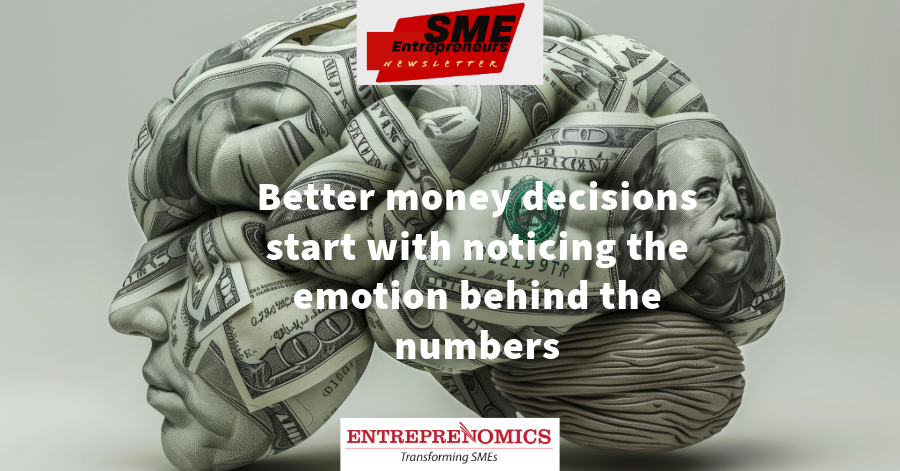
Key takeaways
- Money decisions are rarely purely rational. Emotion often drives when you invest, cut costs, raise prices, or hold back.
- Fear can protect the business, but it can also limit growth. It may stop reckless spending, but it can also lead to underinvestment in people, tools, and marketing.
- Optimism needs evidence. Entrepreneurial confidence is powerful, but unchecked optimism can create overcommitment, weak margins, and cash strain.
- Pricing is often tied to identity. When business owners separate personal doubt from commercial value, it becomes easier to charge sustainably.
- Rules beat pressure. Cash flow stress narrows thinking, so simple decision rules set in advance help you make calmer choices when pressure rises.
Money decisions in business are rarely just about numbers.
On paper, a decision might look simple: cut costs, raise prices, hire support, invest in marketing, or hold cash. In reality, confidence, fear, experience, competitive pressure, and the desire to keep moving shape those choices.
This is your bi-weekly SME Entrepreneurs Newsletter with more in-depth analysis.
For SME entrepreneurs, this matters. You often make financial decisions without a large finance team, without perfect data, and with your own income tied closely to the outcome. That makes psychology part of the job.
The goal is not to remove emotion from money decisions. That is unrealistic. The goal is to notice the emotion, slow the decision down, and create a clearer process.
Fear can make you too cautious
Many entrepreneurs become conservative after a difficult month, a failed campaign, or a cash flow scare. That caution can be useful. It can stop reckless spending and force better planning.
But fear can also lead to underinvestment. You delay hiring even when you are at capacity. You avoid marketing because the return is not guaranteed. You keep prices too low because you worry customers will leave.
A useful question is: Am I saying no because the numbers do not work, or because I feel exposed?
If the numbers do not work, pause. If the feeling is fear, look for a smaller test. Instead of avoiding the decision entirely, reduce the risk. Trial a contractor before hiring. Test one campaign before committing to a full budget. Increase prices for new customers first.
Start Your Entrepreneurial Venture
Start 2027 early so you can achieve your dream of owning your own business. Register for the 1-hour webinar and receive your free article, "Common errors entrepreneurs make".
Register: https://www.entrepreneurtnt.com/start-your-entp-venture

Optimism can move too fast
Entrepreneurs need optimism. Without it, few businesses would survive the early stages. But optimism can become dangerous when it replaces evidence.
This often appears as overestimating future revenue, assuming late payments will arrive on time, or committing to fixed costs before demand is proven.
Before making a major spend, run three scenarios: expected, slower, and difficult. Ask what happens if revenue is 20% lower than planned or payment arrives 30 days late.
If the decision still works, it is stronger. If it only works in the best-case scenario, it needs more thought.
Identity can affect pricing
Pricing is one of the most emotional money decisions in business.
Many owners do not simply ask, “What is the value?” They also ask, often unconsciously, “Who am I to charge this?”
This can lead to underpricing, over-servicing, and resentment. The business is becoming busy but not profitable.
Good pricing is not about ego. It is about sustainability. If your price does not cover delivery, overhead, tax, reinvestment, and profit, the model is weak. Customers are not served well by a business that cannot afford to stay healthy.
Review pricing with distance. Look at margin, demand, outcomes, and capacity. Treat price as a business design decision, not a personal judgement.
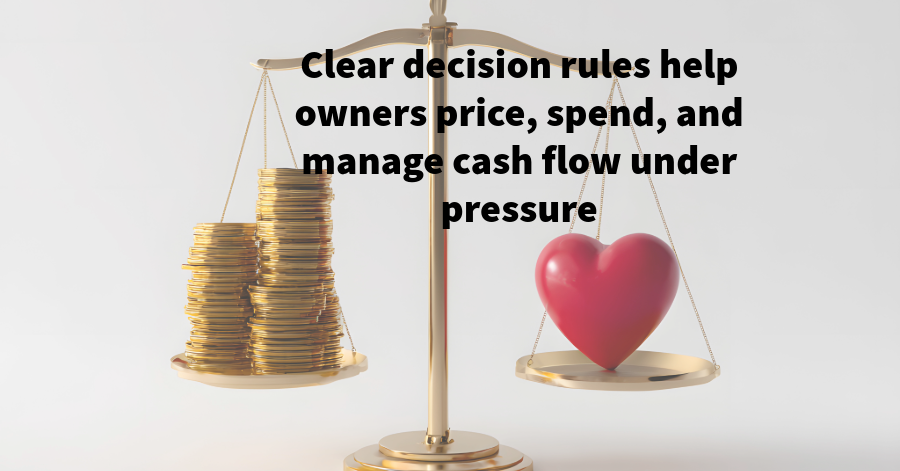
Cash flow pressure narrows thinking
When cash is tight, the brain prioritises immediate relief. This is natural, but it can create short-term decisions with long-term consequences: accepting poor-fit clients, discounting too quickly, delaying supplier conversations, or ignoring tax obligations.
The best protection is a simple cash rhythm.
Review cash weekly. Track what is coming in, what is going out, and what decisions you need to make in the next 30 days.
A regular review reduces surprises. Fewer surprises mean better decisions.
Family businesses need succession
If you own a family enterprise and need insight into the succession process, sign up for the webinar and receive your free article, "Family businesses need a paradigm shift".
Register: https://www.entrepreneurtnt.com/start-your-entp-venture
Create rules before pressure hits
The most reliable money decisions are made with rules set in advance.
Rules reduce decision fatigue. They also help you act consistently when emotions are high.
Better financial decision-making is not about becoming less human. It is about building habits that help you think clearly when the stakes feel personal.
Over time, these practices create more than better financial outcomes. They create a calmer, more confident way to lead the business.
Ask Sajjad
Fill out the contact form here.
See you in two weeks for another edition of your SME Entrepreneurs Newsletter. May you always have the mindset of an entrepreneur.


Sajjad Hamid is an SME & Family Business Adviser who supports entrepreneurs in scaling their ventures. In his spare time in Trinidad and Tobago, he cultivates organic tropical fruits and vegetables, practising sustainable farming in his home garden.
He is the author of Build Your Legacy Business: Solopreneur To Family Business Hero. Sajjad is a Fellow of the Family Firm Institute. He writes a column titled Entreprenomics in the Business section of the Trinidad and Tobago Guardian. You can contact him at [email protected] or visit www.entrepreneurtnt.com.

Responses